Sunday, 7 August 2016

"Common" Redpoll

We were up this morning at 3.00am and nets were up by 4.00am. These are the normal times every day on these trips to Norway. It was overcast and damp and the forecast said it would rain around 6.00am. As it turned out we were able to ring until about 0830am. We closed the nets but came back to the site at about 1.30pm for another session before getting rained off again so we decided to call it a day. Considering the conditions we did catch 332 birds over 16 species which included a House Sparrow and Pied Flycatcher from the garden of the house we are staying in.. See below for breakdown.


The number of Brambling improved from yesterday. It was nice to see males with a really black head.  This bird although not showing signs of a main moult is probably due to start at anytime and the new head feathers will be tipped greyish and by next years breeding season these tips will have worn off exposing the black part of the feather underneath.


On a couple of occasions we have had a couple of birds together. This gives you the opportunity to compare their different sexes and some of the finer points of ageing. In particular the top bird is aged as a second year because you can see the brown unmoulted alula feathers.


Yesterday Bluethroat were top of the species list but today it was Redpoll with 127 birds being caught and processed. This adult male was a stonker in its full breeding colours.


Lapland Buntings (also known as a Lapland Longspur) in the past have been relatively small in numbers and this bird today was the first to be caught this trip. They breed in upland scrub areas, tundra and areas of bare mountains. Breeding male has a black head and throat.


Ten new Redwing today, this bird above is a bird born this year


Finally another bird born this year a Fieldfare. The juvenile has white to pale grey edges to its coverts.

Finally a breakdown of species and numbers caught today are below.


Species
Number Caught
Reed Bunting
28
Bluethroat
21
Meadow Pipit
26
Willow Warbler
64
Redpoll
128
Brambling
22
Sedge Warbler
4
Fieldfare
11
Great tit
5
Redwing
10
Greenfinch
4
Restart
4
Arctic Redpoll
2
Lapland Bunting
1
House Sarrow
1
Pied Flycatcher
1
Total
332


Tomorrow we hope to erect some nets on the beach to catch waders. There are large numbers about at the moment and would like to be ready for the incoming tide which concentrates the bird numbers to smaller feeding areas which should improve our chances to catch them. Today we have seen Dunlin, Little Stint, Curlew Sandpiper, Ruff, Redshank and Ringed Plover.


Saturday, 6 August 2016

Off to a flying start

It was a long day yesterday, for myself my journey started on Thursday 4th when I left home in SW Wales at 6.00pm. We got to Nesseby at about 10:45pm local time and we made the decision to have a lie in. Ou exact location is a few kilometres away from Vadso which can be seen in the very top right sitting on the north shore of the Varanger Fjord. This area is about 550km north of the Arctic Circle


This morning began at a very leisurely 8.00am start and first job was to check the equipment which was delivered by the team at Biotope, as ever our thanks for this! Nets, poles, guys, table, chairs and the all important rings present and correct.  Once loaded into our rather snazzy VW Passat (a super posh model) we headed for the ringing site using the expert driving skills of Dr Colin.  Then came the real work, cutting the 16 new rides and then erecting the nets.  With all the work needed for setting the site up it was 11.45am before we were ready to start catching birds.

The late start would usually count against us but we still managed a respectable 206 new birds of 11 species.  A breakdown can be seen below, along with some of the highlights.


The Bluethroat we caught were nearly all this years juveniles as were most of the other species as well. Their moult was very variable ranging from complete juvenile moult to completed post juvenile moult.


This is a very scruffy Whinchat and the only one caught today. It was in its main moult and had also lost its tail feathers. The habit they like is open scrub grassland with the odd scrub trees scattered around where they like to perch. They are solitary birds and this as far as we know is the first for the area.


The Whinchat had started its main moult including its primary feathers


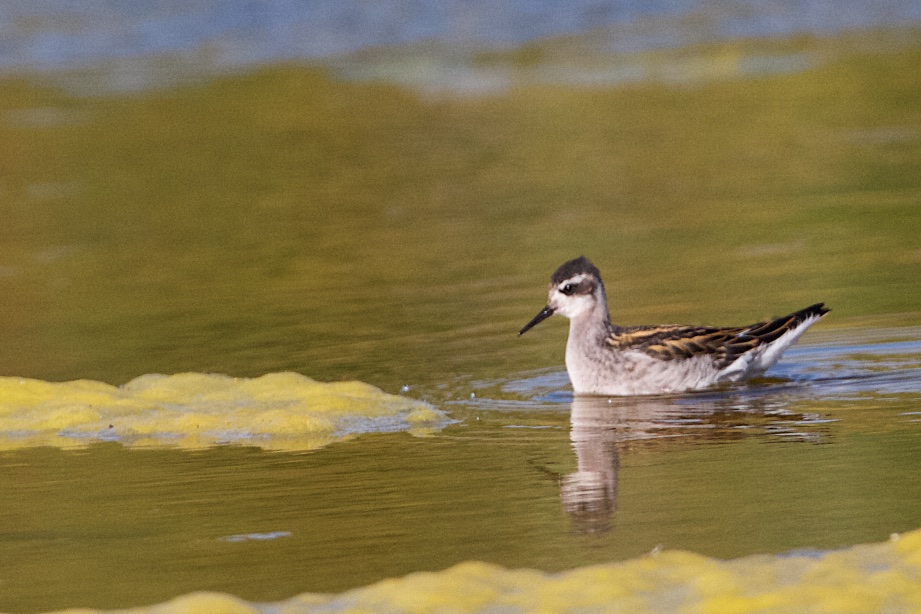
Red necked Phalarope. Named because in the breeding season on its neck is red.


Ruff.  Still a beautiful bird even in juvenile plumage.

One of the highlights for today was a Control Brambling originally ringed in Sweden. Again we believe this is the first foreign control for the site. We are not being greedy but Swede like another one!

Tomorrow will be our first full day of ringing, so an early start beckons.  As well as operating our nets in the areas of willow scrub, we'll be looking at our options for waders along the shoreline.  When we arrived this morning several hundred birds including Curlew Sandpiper, Ruff, Little Stint, Dunlin and Redshank were feeding just a few feet away from the car.


Species
Number Caught
Reed Bunting
30
Bluethroat
58
Meadow Pipit
42
Willow Warbler
34
Redpoll
15
Brambling
6
Sedge Warbler
1
Fieldfare
9
Whinchat
1
Redwing
7
Greenfinch
3
Total
206

Tuesday, 2 August 2016

Varanger, Arctic Norway.

This Friday 5th August five of us will be flying out from Manchester for the first leg of our long journey to Arctic Norway. We will be bird ringing on our site at Nesseby on the North bank of the Varanger Fjord for 10 days. The team of 5 this year are Dave, big Col (little Col could not make it), myself Charlie and two virgins Scott and Paul who have ringed in the Pasvik Valley bordering Russia last year but never at Nesseby. The makings of an excellent experienced team.

The whole purpose of our expeditions is to help our sponsor Tormod Amundsen of http://www.biotope.no promote Varanger as a birding destination. Without his help and generosity this project would never have got off the ground.

In previous years we have caught small numbers of waders and our Norwegian friends have always intimated an earlier visit to Varanger would be beneficial because our normal visit times sees the start of wader migration and the number of birds start to reduce very quickly. The unknown quantity for us is we might be a little early for the start of migration of breeding passerines, in past years we have timed it perfectly and 350 birds in one day was not unusual.


Our ringing site is adjacent to the beach of the Nesseby church in the municipal county of Finnmark which overlooks the Varangerfjorden. The church was built in 1845 and was one of a few to survive  World War 2.


The beach from the church to the ringing site is probably a quarter of a mile, so plenty to go at.


A picture from 2 years ago, our ringing station being set up.The tent is called a Lavvu and is a temporary dwelling used by the Sami people of northern Scandinavia. It lets the indigenous people of the plains of northern Scandinavia and arctic to follow and look after their reindeer herds. It's use is being more commonly used by people who love camping.


Dunlin

All the birds above and below have been caught from Nesseby in previous years. I have posted these pictures just as examples to give you a taster of what is possible. Fingers crossed we will have a good time.


Ringed Plover

Our visit this year is earlier than normal. As mentioned above it is intentional because we are hoping there will be plenty of waders to be caught before they start their migration. In previous years we have caught Dunlin, Ringed Plover, Little Stint and Curlew Sandpiper from the beach by the church. We are hoping for a few more species on this trip.


The nominate Willow Warbler trochilus is on the right and acredula found in northern Scandinavia and northern Russia is on the left. Discernible when you have them side by side but not as easy if this is not the case.


The Barred Warbler breeds in temperate regions of central and eastern Europe and winters in tropical Africa, so to get one as far north as Varanger is a rarity indeed. It was also confirmed as a first for Finnmark. That's one of the things I love about ringing you never know what will turn up in the nets.


Not a passerine but birds like this Merlin are always great to catch.


The Siberian Tit is a bird slightly smaller than a Great Tit. It is not rare or uncommon in the Finnmark region of Norway and the north of Russia but numbers caught are not huge 35 were caught last year and about half that many the year before.

Finally we will be there from the 5th to the 15th of August and will be happy to give ringing demonstrations if you should be in the area We are looking forward to seeing our Dutch friends Petra and Frank and Lee and Bernadette from Blighty who travel as part of their holiday to Norway and stay in their camper vans for 4 or 5 nights at Nesseby. Don't forget the biscuits! See you soon.

Monday, 18 July 2016

Eilean Nan Ron

Our visit to Eileen Nan Ron is an annual trip we make to this most northerly island off Scotland where we spend three nights camping. It was inhabited until 6th December 1938 because life for the inhabitants of the Gaelic speaking community on the one mile long island had become just to difficult and when the final evacuation came there were 4 men and 5 women of 3 families left. All that remains now are the stone built houses and cottages that have fallen into decay and ruin. Nan Ron is just to the east of the mouth of Tongue bay in Sutherland.


The timing plan of our visit coincided with no moon, so night time mist netting for Stormies would be at its darkest. Also at this time of year the nights are very short and there is only a short window of darkness to catch them. We had 3hrs and the sun was starting to rise again.


We leave the mainland from a village called Skerry. The lady in the picture Jean takes us across in her little boat. It takes two journeys to do this for the seven of us and our equipment including the net poles as can be seen in the picture. She really is a good boats woman.


The plan of course ringing at night for Storm Petrels and then other activities during the day. This juvenile Snipe was caught in a 60ft mist net erected in a huge area of bracken. On previous trips to the island we have experienced on two occasions snipe going into the net but before being able to get to them they managed to fly out.


Scott enjoying the comforts of my tent whilst we pass away a few hours when the weather is inclement. A couple of the ruined houses can be seen in the background in this amazing landscape.


We had one Rock Dove which are only found along the west and north coasts of Scotland, also on off shore islands like Eileen Nan Ron and the coast line of Northern Island. This bird was frequenting one of the ruined building


One of the highlights for me were the 11 pulli of the Great Skuas also known as Bonxies. We locate the pulli by walking around the island until we found one usually lying amongst heather, the parents being not too far away. We then make a judgement on the size of the bird because a small bird has a small leg and foot and a ring applied could easily slide off.


This bird and the one above are different birds. The top one is more advanced as can be seen by the growth of the wing feathers


This little bird is probably only a day or so out of the egg and even at this age it can have attitude.  It still has its white egg tooth and at this age the parents are at their most aggressive. because of the youngsters vulnerability. Unlike the more mature pulli it is far to small to be ringed.


Bonxie is a Shetland name given to the bird and probably derived from a Norse word "bunki dumpy" it is famous for its aggressive behaviour and defends its territory especially against humans. They will eat carrion, sandeels and often kill gulls and other sea birds or neighbouring chicks when food is in short supply.
To give you some idea of the size of this aggressive bird: They are about 50-58cm long with a wingspan of 125-140cm and an average male weight of 1.27kg and females 1.41kgs. In the UK there are about 9600 pairs of birds. I have taken this information from the internet.


One evening we came across this insect. As far as I am aware this is a Common Sea Slater. It is a sea shore relative of the Common Woodlouse and grow to at least 3cm long. In the picture is a one penny to give some scale. 


Setting up the ringing station ready for the evening Storm Petrel session


The Storm Petrel above as you can see is not a big bird. Probably the smallest of the sea birds which feed on plankton crustaceans and small fish picked of the surface of the sea, usually whilst hovering above.


As in previous years we caught birds that had a leg missing and it is thought they lose their legs from attacks by fish. Every bird caught with a leg missing appeared to be very healthy and the leg stump was perfectly healed.
In the UK their breeding grounds are generally on the west coast and the northern isles. It only comes ashore to breed and at night. Their nests can be found in crevices and burrows.


The total birds for the trip were:

Stormies
New birds = 468
Retraps = 101, one bird 20 yrs old
UK Controls = 24
Lisbon control = 1

Other birds
Bonxie = 11 pulli
Twite = 2
Meadow Pipit = 3
Rock Dove = 1


Tuesday, 29 March 2016

Vestre Jakobselv Skole Bird Ringing in Arctic Norway, a different way.

An important part of my bird ringing are the trips abroad. Last year was my second visit to Arctic Norway. The first time I went with friends to Nesseby on the north shore of the Varanger Fjord. We had two local schools visit us on separate days and they followed us around to learn about bird ringing. Some of the students and teachers from the Vestre Jakobselv Skole camped for a few nights and really enjoyed their visit.

Last year we went to a place called Pasvik which is on the south side of the Varanger Fjord on the border with Russia. We had local school children again visit us and we were pleasantly surprised when the Vestre Jakobselv Skole children and teachers came to see us again and had driven about 150km to get there.


Colin talking to the teachers and one of the pupils from the Vestre Jakobselv Skole about the Reed Bunting


They stayed a couple of nights and on their last day the teacher told us the children each evening after we left the ringing site had been doing rehearsals together and they had something to show us. They acted out a wonderful performance of bird ringing. It was amazing the detail they had learnt, understood and performed. This video shows what happened. Their English was perfect, a credit to the Norwegian education system, I hope you enjoy it.

Friday, 25 March 2016

You Tube

I thought I would have a go at posting video on You Tube and then downloading ones I like to my blog. There are so many videos available to look at these days I thought it couldn't possibly be difficult to set up an account. I wasn't wrong, in all about 10 mins to set it up and add a video. Mind you, I did a have a little help from the local farmers son, Ben, age 15.


This first video was taken during CES8 at the Wildlife and Wetland Trust (WWT) Llanelli last year on the23rd July. The two Kingfishers were caught in net 4 right at the end of the session and were a complete surprise. This gave me the opportunity to try the video option out on my camera. Kingfishers can turn their heads nearly 360 degrees and the video clearly shows this. I understand that humans and some animals move their eyes to follow or scan an object using peripheral vision when necessary. Kingfishers eyes are more fixed in their eye sockets and do not have the same wide vision of movement so the turning of their heads helps to compensate for this.


Video 2 of the Great Northern Diver was taken on our way to a small Island called Eilean nan Ron off the coast of the Northwest Highlands of Scotland. I go there every summer with friends for the purpose of catching Storm Petrels Great Skua pulli, Shag and Twite.


We had a rest break from the journey along the water side of one of the large Scottish Loughs and this Great Northern Diver swam past us. Such beautiful birds and the largest of the UK Loons. It is usually seen in the Winter months but some can be seen in the summer in the north of the UK. It has an Amber Status.


If anyone has any constructive criticism about my videos I would love to hear it, because if possible I would like to improve them in future attempts. Especially I would like to know how videos can reach a wider audience. Thanks for looking.